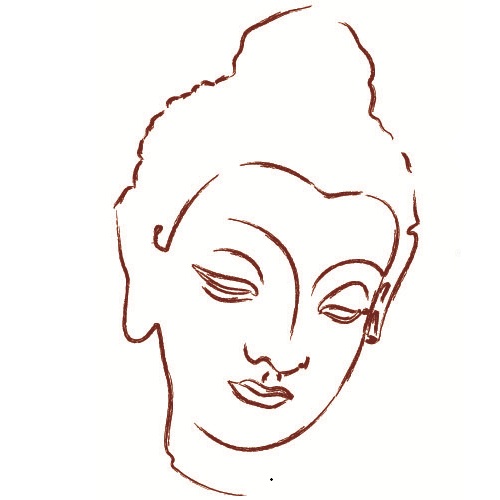
The Four Noble Truths
इदं दुखं | "This is pain"
अयं दुख समुदायो | "This is the origin of pain"
अयं दुख निरोधो | "This is the cessation of pain"
अयं दुख निरोध गामिनी प्रतिपदा | "This is the path leading to the cessation of pain."
Suffering - Dukkha
Life is not perfect. Everything can be a source of disappointment and sorrow. When we are unable to satisfy our wants or lose something we are attached to, it will give rise to sorrow.
Happiness of gaining something is temporary. Attachment towards what we have or desire to gain more will always be there. There will always be a feeling or dissatisfaction or unfulfillment or sadness. This is the cause for all sorrow or Dukkha.
Some may find this truth about sorrow being inevitable a pessimistic view. However, making people aware about the real world not being perfect is being realistic. People should be aware that some suffering is inevitable in this world. Only when we know the truth about sorrow or Dukkha, can we find a way to overcome it.
Cause of Suffering - Samudāya
It is natural for humans to have desires, to want things, once they get something to become attached to it, and then want more. This taṇhā or thirst, craving, or desire for something causes suffering when you are unable to fulfill it. Craving can be for pleasures of the five senses, or to continue to be a part of the material world, or it can also be a desire not to experience any sorrow.
Samudaya means the inevitable coming together of samsara and tanha resulting in dukkha. They are all connected and come into existence together.
Anatta or Anātman : Non Self
One of the core principles of Buddhism is that there is no concept of an permanent or unchanging soul or self in a living being.
It teaches that human existence is merely an interdependent collection of five physical and mental aggregates.
Understanding this concept helps unbind individuals from ego, possessiveness, and personal attachments.
By recognizing the absence of a fixed self, practitioners work toward overcoming spiritual ignorance and suffering.
Anicca : Impermanence
The fundamental truth that all compounded physical and mental phenomena are inherently impermanent and transient.
Everything in existence is in a continuous state of flux, arising, changing, and eventually passing away.
Failing to accept impermanence leads directly to dissatisfaction when individuals cling to fleeting experiences.
Realizing this principle deepens mindfulness and encourages non-attachment to worldly conditions.
Arahat : Enlightened Person
A fully enlightened individual who has destroyed all mental defilements, cravings, and spiritual ignorance.
Having successfully followed the Noble Eightfold Path, an Arahat has attained Nirvana within their current lifetime.
Because the seeds of attachment and karma are completely eradicated, they are liberated from future rebirth.
In early traditions, the Arahat serves as the ultimate spiritual ideal of individual liberation.
Atman or Atta : Soul
The belief in an eternal, independent, and immutable self or soul residing within a living being.
While central to traditional Indian philosophy, Buddhism explicitly denies the absolute existence of Atman.
The Buddha taught that clinging to an ultimate self creates deep-seated delusions and perpetuates suffering.
In Buddhist contexts, the term is primarily used contrastively to emphasize the doctrine of *Anatta*.
Dana : Charity
The practice of intentional generosity, giving, and selfless charity toward spiritual teachers and all beings.
It forms the foundational virtue in Buddhist training, helping to cultivate detachment and weaken greed.
Giving can take the form of material resources, spiritual wisdom, protection, or personal assistance.
Practicing generosity creates positive karmic momentum and softens the boundaries of the self.
Dhamma : Teachings of the Buddha, Righteousness
The universal truth, natural law, and cosmic order that governs the reality of all existence.
It refers specifically to the body of spiritual teachings and doctrines delivered by the historical Buddha.
Practicing Dhamma serves as the practical guide to ethical living, mental clarity, and final liberation.
It is recognized as one of the Three Jewels in which practitioners take refuge.
Dukkha : Suffering
The fundamental unsatisfactoriness, stress, and suffering that characterizes all conditioned existence.
It spans obvious physical pain, the anxiety of change, and the subtle friction of impermanent states.
Dukkha arises directly from craving, ignorance, and misinterpreting reality as permanent or static.
Understanding Dukkha is the first step of the Four Noble Truths, initiating the search for freedom.
Karma : Act or Action
The law of moral causation where intentional actions of body, speech, and mind yield corresponding results.
Volitional choices rooted in greed, hatred, or wisdom shape a person's immediate and future realities.
It operates as an impersonal natural law rather than a system of divine reward or punishment.
Understanding karma emphasizes personal responsibility for one's current state and spiritual development.
Karuna : Compassion
The active quality of compassion characterized by the sincere desire to relieve the suffering of others.
It arises naturally when empathy observes distress without turning away or lapsing into despair.
Practicing Karuna involves actively working to alleviate harm through selfless action and gentle speech.
It is cultivated as one of the four Sublime States (*Brahmaviharas*) in Buddhist meditation.
Metta : Fraternal Kindness
The practice of loving-kindness and unconditioned goodwill extended universally to all living beings.
Unlike attachment-based affection, Metta is selfless, seeking the genuine happiness and peace of others.
It serves as a direct antidote to hatred, anger, ill-will, and social division.
Regular cultivation of loving-kindness softens the heart and stabilizes concentration during practice.
Prajna : Wisdom
Transcendental wisdom and direct intuitive insight into the true, unvarnished nature of reality.
It sees beyond superficial appearances to perceive impermanence, non-self, and interconnectedness clearly.
Prajna is developed through a combination of ethical conduct, meditation, and analytical contemplation.
This liberating insight serves as the essential key that dismantles ignorance and yields enlightenment.
Pratitya-Samutpāda : Dependent Origination
The doctrine of Dependent Origination, stating that all phenomena arise in dependence upon cause and condition.
Nothing exists independently or spontaneously; every entity is bound within a web of causality.
It explains the cyclical mechanism of rebirth through a sequence of twelve interdependent links.
Understanding this principle removes belief in a creator god, absolute randomness, or static substances.
Satya : Truth
The concept of fundamental truth or reality as articulated within the core Buddhist teachings.
Most famously expressed through the Four Noble Truths, which diagnose the origin and end of suffering.
Mahayana traditions also distinguish between conventional truths and ultimate, unconditioned reality.
Living in alignment with Satya requires truthful speech, honest self-examination, and clear vision.
Shunyata : Nothingness
The Mahayana realization of "emptiness," meaning all phenomena lack inherent, independent existence.
Rather than nihilism, it signifies that things exist interdependently, devoid of a fixed essence.
Realizing Shunyata dismantles rigid concepts, dogmatic attachments, and dualistic thinking patterns.
It highlights the absolute interconnectedness of reality, revealing form and emptiness as undivided.
Sila : Right Conduct
The commitment to ethical conduct, moral virtue, and intentional self-restraint in daily life.
It forms the indispensable foundation for meditation and wisdom within the Noble Eightfold Path.
Practiced through guidelines like the Five Precepts, it protects oneself and others from harm.
Clear ethical boundaries calm the mind, preventing guilt and establishing mental stability.
Theravada : Word of the Elders
Literally means the "The Word of the Elders" - The "School of the Elders," representing the oldest surviving tradition of contemporary Buddhism.
It bases its core doctrines and monastic disciplines strictly on the ancient Pāli Canon.
The tradition emphasizes individual effort, monastic practice, mindfulness, and attaining Arahatship.
Sankaracharya and the Enlightened Chandala
One summer noon, the Sankaracharya along with his disciples was walking towards the Ganga for his midday rites.
On the way, he and his disciples encountered a Chandala* who was walking from the opposite direction along with his dogs. Seeing him, the Acharya says "Move, move, so that I may pass".
*A Chandala is an untouchable and one of the lowest castes whose shadow is also said to be polluting.
The Chandala replies, "O worthy Brahman, please let me know what I should move out of your path. Do you want me move my physical body or my soul?"
He further asks, "Is there any difference between the reflection of the sun in the waters of the Ganga and the reflection of the sun in the water in the Chandala's vessel? Is there any difference in the space in a golden jar and that within a clay pot?"
He pointedly questions, "From where did you get the delusion that you see yourself as a brahmin and me as a chandala and ask me to move away? Is it because you did not realise that the supreme soul exists everywhere and pervades every soul?"
He laments that, "Even after obtaining supreme knowledge that can lead to salvation, some people believe that they should control other people; Alas, even great sages succumb to the illusions of the Lord."
Hearing this, Sri Sankaracharya said, "O best among men, what you speak is the truth. On hearing you, I have realised that you are a realised soul and not a mere Chandala. He who has realised the Self and the Supreme Knowledge, whether a brahmin or a chandala is to be respected and is my preceptor."
Freedom to Believe or Not to Believe
The 14th Dalai Lama believes every person on this earth has the freedom to practice or not practice religion. It is all right to do either. Religion is a deeply personal matter primarily meant to cultivate inner peace, love, and compassion. Every person can follow any belief that calms his agitated mind.
One can have faith in whatever religion one chooses to believe, but one must also respect all other religions.
We are reproducing the following article for people who are unsure about how to handle delicate situations with compassion.
Rohini S Murthy
31 August 2026
"To pray or not to pray" was the dilemma my friend Anita faced as a 10-year-old. As children growing up in the 1980s, our interaction at school was largely limited to studies and games. In the absence of social media, or any other form of communication, our personal lives remained strictly personal.
A chance encounter with Anita a couple of weeks ago helped me understand the unique impasse she faced at home as a little girl. Both her parents were atheists and she paid little heed to the absence of a pooja room at her home. However, as the years rolled by, she would overhear her neighbours and classmates discussing the festivities and the sumptuous meals they had on special days. At such times, she felt there was something amiss at her place.
Seeing her sullen expression one day, a close friend probed the reason behind her sorrow. Anita simply said, ‘There is no place for God in our house.’ In all innocence, her friend said, ‘But I have come to your house; it’s so spacious. How can you say there is no place?’ That is when it struck her that she had already made a place for God in her heart but felt the need to divert her abstract devotion into a tangible form. She reached home and pleaded with her parents to buy a photo of Shiva. ‘Why Shiva? Why not any other god?’ asked her puzzled father. She replied, ‘Every time I close my eyes, the image of Shiva comes to my mind.’ Her reply obviously stunned her dad, but he dismissed her wish as a passing fancy. However, Anita stood her ground. Soon enough, her father purchased a framed picture of Lord Shiva. ‘God’s entry into my home filled my heart with immense happiness,’ she smilingly recollects today.
It has been over four decades since Anita’s ‘spiritual’ journey began. She finds peace and solace in going on pilgrimages, fasting on auspicious days, and strengthening her communion with the divine. Their family dynamics around faith could easily have spiralled into discord and bitterness, but they chose mutual respect, clear boundaries, and open communication instead. They accepted one another’s beliefs without judgment, ridicule, or attempts at conversion. If humanity could cultivate a similar empathy of respecting faith rather than trying to alter or challenge it, our society could truly become one big happy family. This quote by Sri Chinmoy sums it up aptly – inner compassion and outer tolerance can easily make a better world.
Copyrights belong to the author, holders, publishers as the case may be.
The Story of the Enlightened Butcher from the Mahabharata
Kaushika was his parents' only son. He was devoted to his parents, yet restless and ambitious in seeking a higher plane of spirituality. Since he was young, devotion and ego both were blended in him.
"Mother, father," he said one day, " I want to go off into the jungle and devote myself to spiritual studies."
His parents were distraught.
His mother said with concern, "But son, your father and I are very old. Your father is so sick he can hardly move. If you go away, what will happen to us? Who will attend to our needs?"
Kaushika was in no mood to listen as his mind was fixed on his spiritual goals. He was determined to study the Vedas.
His mother cried in vain as she watched her son turn his back on her and leave for the jungle.
Eventually, through great austerity and severe penance, Kaushika acquired great mystical powers.
One afternoon, as he was meditating under a tree, a crane flew up, and perched herself on a branch above Kaushika. Some bird droppings fell on Kaushika's head. Kaushika was furious and threw a fiery gaze at the crane.
The crane immediately fell dead.
The sage immediately was filled with remorse over what he had done. "How could I have allowed my anger to take over me that way?", he mourned. But, he was also proud of the powers he had acquired.
Later in the day, he went to a village to beg for alms. The lady of the house asked him to wait and went to get some food. Right then her husband arrived. She immediately set aside the pot of food she was taking to the sage and went to attend her husband.
After washing his feet, giving him food, and attending to his needs, she came back out to give the alms to the sage. The sage who had waited for a long time by now felt insulted. "You put your husband before a pious sage? Do you know the power of a Brahmin?"
She calmly replied, "Yes, a true Brahmin is he who has mastered his anger. Please do not threaten me, I am not a crane that will die by your fiery gaze."
The sage was stunned. "How does she know about the crane?" he wondered.
The lady continued, "Oh holy one! You are a learned Brahmin but you have not understood the truth about virtue. If you want to be enlightened, go to Dharmavyadha who lives in Mathura. Any one will tell you where he lives."
The sage thanked the lady and hurried to Mathura. "He must be a great and learned sage indeed," Kaushika thought to himself.
But when he finally reached Dharmavyadaha's place, he found it to be a butcher shop!
A very ordinary looking man came out and said, "Welcome holy one. I am Dharmavyadaha, the man you seek."
"How can a butcher be spiritually enlightened?" Kaushika wondered in amazement.
Dharmavyadaha smiled and said with compassion, "I know the story of the crane and of the woman who sent you here. Come, let us go to my house. "
The sage could not contain himself and blurted out, "But butchering animals is such a sinful profession! Are you not ashamed?"
"I am not," the butcher calmly said. "I am engaged in my family trade. I work hard and honestly at it. There is no reason for me to be ashamed of my work!"
"Holy one," continued the butcher. "If I do injury to other creatures, so do you and others. "
"As we walk on the soil, we are trampling on numerous creatures. Nor is the air devoid of creatures."
"You see that farmer tilling the land? He is killing so many animals that thrive under the soil."
They reached the butcher's house. The butcher's wife was doing her house hold chores and his two boys were playing.
The butcher introduced the sage to his wife and boys.
Then the butcher entered the house and touched his parents' feet and introduced Kaushika to them.
Before leaving the room, the butcher remarked, "My parents are my Gods. My wife and my children attend to them with devotion and love. We consider caring for them to be our greatest duty. That is our dharma."
"In doing one's duty cheerfully, lies true virtue. This is what the dutiful wife sent you to learn."
"Oh learned one!" the butcher continued, "You have run away from your responsibilities and deserted your aged father and mother. Spiritual achievement is useless if one has neglected one's Dharma, or duties."
The sage remembered his mother crying, "Who will look after us when you are gone my son?"
The sage apologized, "You have shown me the path of true virtue, the true meaning of Dharma, Oh pious one. I am deeply indebted to you."
Kaushika immediately returned to his parents and served them with devotion till the end of their days.
The Commitment of King Shibi to Duty - Jataka Tale
This is a Jataka tale narrated by the Buddha to emphasise the need to adhere to duty even at the cost of life itself.
There once was a king by name, Shibi (Sibi in Pali) who was widely known for his virtuosity and was known as the most righteous of all kings who ruled the earth.
King Shibi was performing a great sacrifice and the devas once decided to check if he was really as committed to dharma as reputed. So, Agni (Fire God) assumed the form of a dove and Indra (the King of Gods) assumed the form of a hawk which was hunting the dove. The dove sought refuge in the lap of King Shibi and sought protection from the hawk.
The hawk demanded that Shibi offer the dove he had been chasing. But, Shibi told the hawk that it was his bounden duty to protect anyone who sought his refuge and said he could not give up the dove.
The hawk reminded Shibi that it is the order of nature that a hawk has to hunt for his food and by depriving him of his prey, Shibi was being unjust to him. The king agreed that he cannot allow the hawk to go hungry and said he would be willing to offer some other form of flesh as a substitute for the hawk.
The hawk said if the king cannot give up the dove which the hawk had rightfully hunted, then the king should offer his own flesh in place of the dove and the flesh must be from his right thigh and equal in weight to the dove. King Shibi readily agreed to this.
A weighing scale was brought and the dove was place on one pan and King Shibi cut a piece of flesh from his right thigh and placed it on the other pan. But, the dove was heavier than his flesh. So, the king cut yet another piece of flesh from his thigh and placed it on the scale. They still found that the dove was heavier than his flesh. The king continued to cut his flesh and placed them on the scale, till he realised that the dove weighed more than all the flesh he sacrificed. Finally, the king placed himself on the scale to indicate that he intends to sacrifice himself in lieu of the dove.
Pleased with his commitment to dharma and duty as a king, the two gods revealed their true forms and made King Shibi whole again and bless him.

The Question of who attains Moksha
Sri Kanakadasa (1509 - 1609) was a great poet, philosopher, musician and composer from Karnataka. He is widely respected even today for his simple yet profound teachings. To illustrate the devotion of Kanakadasaru, his guru, Vyasatheertha once asked a group of scholars a very deep question. The question put forth to them was "Who amongst us may go to heaven?".
Some of the scholars and disciples pointed at other scholars based on their piety or penance or knowledge to identify who may go to heaven. Some of them explained why they themselves may go. Finally, Vyasatheertha asked Kanakadasa about who in his opinion may go to heaven.
Kanakadasa simply replied, "Naanu hodare hodenu" or "ನಾನು ಹೋದರೆ ಹೋದೇನು" in Kannada. The simplistic literal translation of this sentence would be "I may go" or "If I go, I might go". The assembled scholars were outraged that Kanakadasa was so arrogant that only he may go to heaven. His guru, Vishwatheertha asked him to explain what he meant.
Kanakadasa explained the deeper philosophical meaning behind his words. He said only if one sheds their ego, then one can attain moksha or one can attain heaven. The actual translation of his sentence would be something like, "If I could go, then I will go." It means that only when one can let go of "I" or your "ego", then one can go. Vishwatheertha smiled and asked the other scholars to understand why one should shed ego and pride while serving either a higher power or humanity.
The translation from Kannada to English cannot never do justice or capture the philosophically deep but beautiful message he spoke in a simple Kannada phrase. But, we have tried to capture the essence as well as possible.